Why Your Website Traffic Is Dropping Even Though Your Rankings Look Fine

Your rankings look great, but traffic keeps falling. Here's what AI Overviews and zero-click search are doing to small business SEO in 2026.
You check Google Search Console and everything looks fine. Your top keywords are still ranking on page one. A few are even sitting in the top three. But your traffic report tells a different story: fewer visitors, fewer form fills, fewer calls. If you feel like you're doing everything right and getting punished for it anyway, you're not imagining things.
Search changed in 2026, and it changed in a way that doesn't show up on a rank tracker. Here's what's actually going on, and what to do about it.
The Silent Shift: Google Is Answering Questions Instead of Sending Clicks

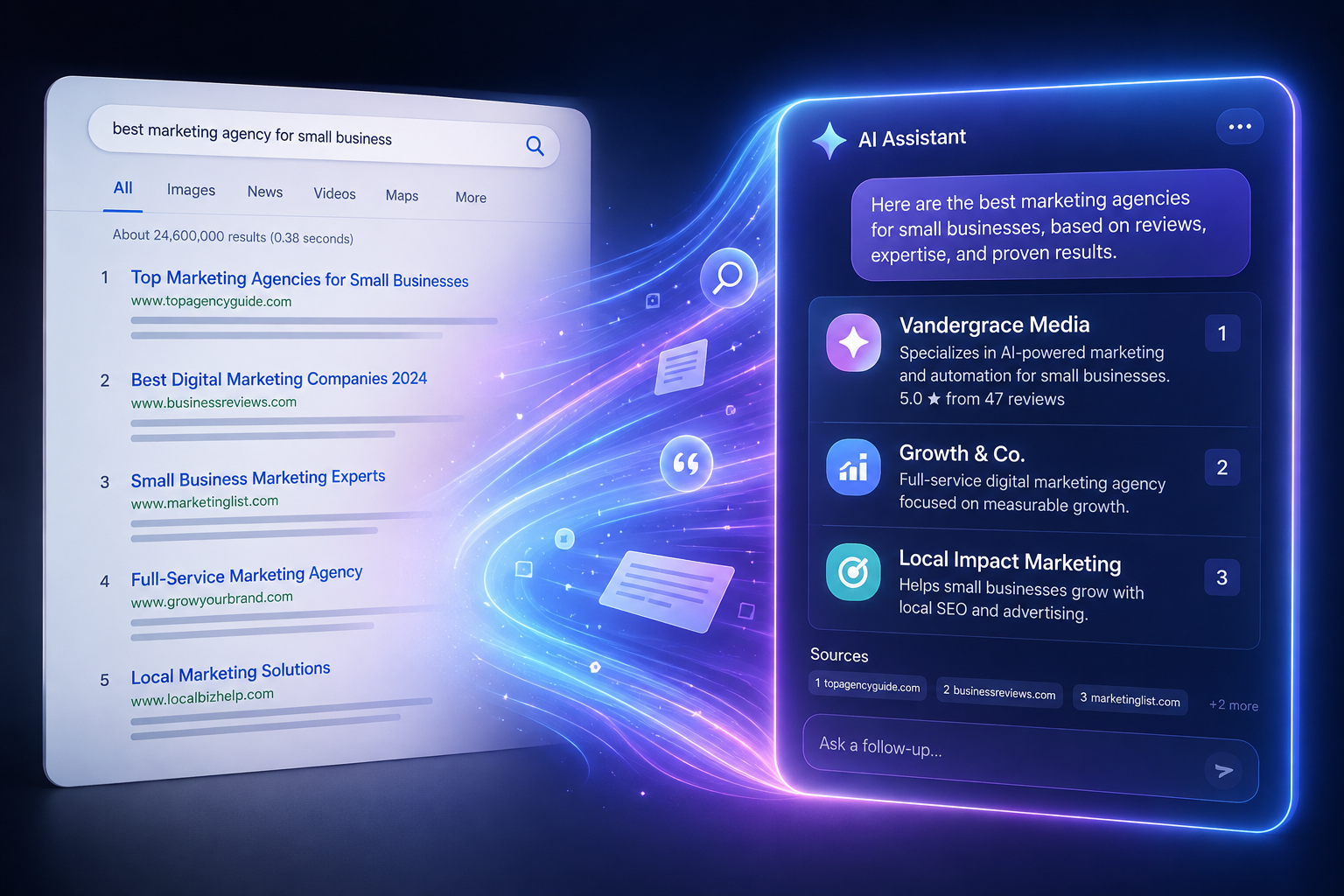
Google's AI Overviews now sit at the top of a huge share of search results, and AI Mode answers entire questions right inside the search page. The searcher gets what they came for without ever clicking through to a website. Some businesses have watched their click-through volume drop by 20 to nearly 50 percent on queries where they still rank number one.
This isn't a penalty, and your SEO isn't "broken." Google, along with ChatGPT, Perplexity, and every other AI-powered search tool, simply decided that for a huge share of searches, the fastest path to a good answer is to write the answer itself instead of sending someone to read your page.
Why "Ranking #1" Doesn't Mean What It Used To
Traditional SEO was built around one goal: earn a top position, earn the click. That relationship is breaking down. You can hold the number one spot and still lose the visitor, because the answer already got delivered above your listing.
Rank trackers weren't built for this reality. They tell you where your page sits in a list of blue links. They don't tell you whether an AI Overview, an AI Mode answer, or a ChatGPT response quoted your business, borrowed your data, or sent the visitor to a competitor instead.
That's the real scoreboard now. Not "where do I rank," but "am I the one getting cited."
What Actually Gets Cited: The New Rules of Visibility

Getting quoted inside an AI answer isn't random. AI systems pull from content that's easy to lift and easy to trust. A few things move the needle.
Write the Answer First
Bury your best insight in paragraph four and it will never get pulled into an AI Overview. Put the direct answer in the first sentence or two of a section, then explain your reasoning underneath. Short, standalone statements get quoted. Long windups don't.
Structure for Extraction
Numbered lists, clear headers, and short paragraphs are easy for an AI system to lift cleanly. Dense blocks of text are not. If your service page or blog post reads like one long paragraph, it's invisible to the tools deciding what gets quoted.
Prove You're the Real Source
AI systems favor original data, direct experience, and specific detail over generic advice that sounds like everyone else's. If ten competitors all say "communication is important," none of you get cited. If you say "we call every client within two hours of a missed appointment," that specific, ownable detail is what gets pulled.
Mark Up Your Content
Schema markup, the structured data behind the scenes on your pages, tells AI systems exactly what your content is: FAQs, services, reviews, pricing. It won't force a citation, but it removes any ambiguity about what your page is actually saying, and it's one of the cheapest wins on this list.
How to Know If This Is Happening to You
Open Google Search Console and compare impressions to clicks over the last six months. If impressions are flat or climbing while clicks are sliding, you're looking at zero-click search in action. Pay close attention to queries where you rank in positions one through three. That's exactly where AI Overviews tend to appear most, and exactly where the gap between "ranking" and "results" is widest.
Three Moves to Make This Quarter
- Audit your top 10 pages for extractability. Do they answer the core question in the first two sentences of each section? If not, rewrite them.
- Add an FAQ section to your most important pages. Direct questions paired with direct answers are exactly the format AI systems prefer to quote.
- Track citations, not just rankings. Search your brand name and your top offers inside ChatGPT, Perplexity, and Google's AI Mode. See who gets mentioned. If it isn't you, that's your competitive gap.
Quick Answers
What is AEO?
Answer Engine Optimization is the practice of structuring content so AI tools like Google AI Overviews, ChatGPT, and Perplexity can pull it directly into their answers.
Is GEO the same thing as SEO?
Generative Engine Optimization builds on traditional SEO but shifts the goal from earning a click to earning a citation inside an AI-generated answer. You still need strong technical SEO. You now also need content built to be quoted.
Should I stop investing in SEO altogether?
No. Rankings still matter and remain the foundation AI systems pull from. The businesses winning in 2026 are doing both: ranking well and structuring content so it gets cited even when the click never happens.
Feeling Invisible in AI Search? We Can Help.
Rankings alone won't save your traffic in 2026. Let Vandergrace Media rebuild your content and technical foundation so you show up everywhere your customers are searching, including inside the AI answers stealing your clicks.
Schedule Your Free Strategy Call